Enzymes are special proteins found in all living organisms. They work like tiny helpers inside the body that speed up chemical reactions. Without enzymes, most reactions in our body would be too slow to keep us alive.
Think of enzymes as “biological tools” that make life processes smooth and fast. From digestion to breathing, from energy production to repairing cells, enzymes are involved everywhere.
They do not get used up in reactions, which means they can work again and again.
How Do Enzymes Work?
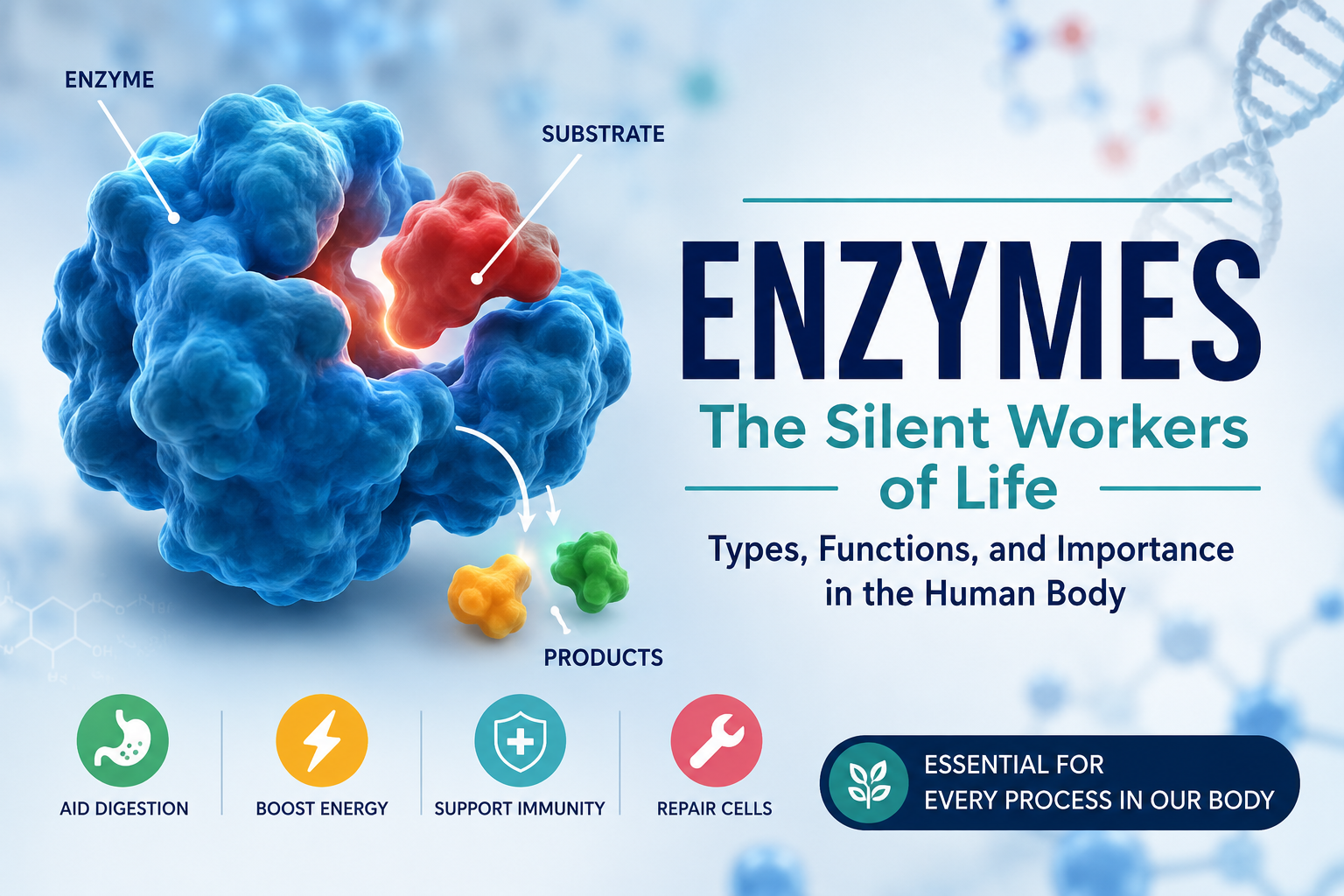
Enzymes work by binding to specific molecules called substrates. They have a special shape that fits only certain substrates, just like a lock and key.
Once the enzyme and substrate meet, they form a temporary complex. Then the enzyme helps convert the substrate into a new product. After that, the enzyme is free again to work on another molecule.
This is why enzymes are extremely efficient and important for life.
Types of Enzymes
Enzymes can be classified in different ways. The most common classification is based on their function:
1. Digestive Enzymes
These enzymes help break down food in the body.
Examples:
- Amylase – breaks down carbohydrates into sugar
- Protease – breaks down proteins into amino acids
- Lipase – breaks down fats into fatty acids
These enzymes are found in saliva, stomach, and small intestine.
2. Metabolic Enzymes
These enzymes control body processes like energy production and cell repair.
Examples:
- Enzymes involved in respiration
- Enzymes that help build or break down molecules inside cells
They are active in every cell of the body.
3. Food and Industrial Enzymes
These are not naturally in the body but are used in industries.
Examples:
- Enzymes in baking (bread making)
- Enzymes in cheese production
- Enzymes in detergents
4. DNA and Genetic Enzymes
These enzymes work with DNA and genetics.
Examples:
- DNA polymerase – helps in DNA replication
- Ligase – helps join DNA strands
Enzymes in the Human Body
The human body produces thousands of enzymes. Some important ones include:
1. Salivary Amylase
- Found in saliva
- Starts digestion of carbohydrates in the mouth
2. Pepsin
- Found in stomach
- Breaks proteins into smaller peptides
3. Trypsin
- Found in small intestine
- Continues protein digestion
4. Lipase
- Works in small intestine
- Breaks fats into fatty acids
5. Lactase
- Breaks down milk sugar (lactose)
- Important for people who drink milk
Functions of Enzymes
Enzymes perform many important roles in the body:
1. Speed Up Chemical Reactions
Enzymes make reactions happen millions of times faster.
2. Digestion of Food
They break food into nutrients the body can absorb.
3. Energy Production
Enzymes help convert food into energy (ATP).
4. Building and Repairing Tissues
They help create proteins and repair damaged cells.
5. Detoxification
Some enzymes help remove harmful substances from the body.
6. Supporting Immune System
Enzymes help fight infections and maintain immunity.
Importance of Enzymes in Life
Without enzymes, life would not be possible. Here’s why they are important:
- Help in digestion of food
- Maintain metabolism
- Support brain and nerve function
- Help muscles work properly
- Allow growth and development
Even a small change in enzyme function can cause diseases or health problems.
Factors That Affect Enzymes
Enzyme activity can change depending on conditions:
1. Temperature
- Enzymes work best at normal body temperature (around 37°C)
- High temperature can destroy enzymes
2. pH Level
- Some enzymes work in acidic conditions (stomach)
- Some work in alkaline conditions (intestine)
3. Concentration
- More enzymes or substrates can increase reaction speed
4. Inhibitors
- Some chemicals can slow down or block enzyme activity
Enzyme Deficiency and Health Problems
If the body lacks certain enzymes, it can lead to health issues:
- Lactose intolerance (lack of lactase)
- Digestive problems
- Metabolic disorders
- Weak energy production
Doctors sometimes treat these conditions with enzyme supplements.
Applications of Enzymes in Daily Life
Enzymes are not only important inside the body but also used in many industries:
1. Medicine
- Used in drugs and treatments
- Help in diagnosis of diseases
2. Food Industry
- Used in baking, brewing, and cheese making
3. Cleaning Products
- Found in detergents to remove stains
4. Biotechnology
- Used in genetic engineering and research
Interesting Facts About Enzymes
- Enzymes are reused again and again
- They are very specific (one enzyme = one job)
- Human body has thousands of different enzymes
- Without enzymes, digestion would take days instead of hours
Conclusion
Enzymes are one of the most important biological molecules in the human body. They act as catalysts that speed up life processes like digestion, energy production, and cell repair.
From breaking food into nutrients to supporting every cell in the body, enzymes make life possible and efficient. Understanding enzymes helps us understand how our body works at a deeper level.
In simple words, enzymes are the “silent workers” of life, always active, always helping, and absolutely essential for survival.