Carbohydrates are one of the three major macronutrients required by the human body, alongside proteins and fats. They are an important source of energy and play a significant role in supporting brain function, physical activity, cellular metabolism, and normal body functions.
Common dietary sources of carbohydrates include rice, wheat, roti, bread, potatoes, fruits, vegetables, milk, pulses, cereals and sugar. After consumption, carbohydrates undergo digestion in the gastrointestinal tract, where complex carbohydrate molecules are broken down into smaller sugars that can be absorbed by the body.
Most digestible carbohydrates are ultimately absorbed as monosaccharides, mainly glucose, galactose and fructose. These simple sugars enter the bloodstream and are transported to the liver and other tissues, where they are used for energy or stored for future use.
Understanding carbohydrate digestion and absorption is important for nutritionists, dietitians, healthcare professionals, students and individuals interested in maintaining good nutritional health.
In this article, we will explore carbohydrate digestion, the organs and enzymes involved, the absorption of glucose and other sugars, carbohydrate metabolism, the role of dietary fibre and factors affecting carbohydrate digestion and absorption.
1. What Are Carbohydrates?
Carbohydrates are organic compounds made primarily of carbon, hydrogen and oxygen. They are one of the body's major sources of dietary energy.
One gram of digestible carbohydrate provides approximately 4 kilocalories of energy.
Carbohydrates are commonly classified into three major groups:
1.1 Monosaccharides
Monosaccharides are the simplest forms of carbohydrates. They cannot be broken down into smaller carbohydrate units through digestion.
The three important dietary monosaccharides are:
Glucose: A major energy source for body cells.
Fructose: Naturally present in fruits, honey, and some vegetables.
Galactose: A component of lactose, the natural sugar found in milk.
Glucose is particularly important because many body tissues use it as a major source of energy.
1.2 Disaccharides
Disaccharides consist of two monosaccharide molecules joined by a glycosidic bond.
Important examples include:
Sucrose: Glucose + fructose.
Lactose: Glucose + galactose.
Maltose: Glucose + glucose.
Disaccharides must be broken down by specific digestive enzymes before their monosaccharide components can be absorbed.
1.3 Polysaccharides
Polysaccharides are long chains of monosaccharides.
Examples include:
Starch
Glycogen
Cellulose
Some forms of resistant starch
Starch is an important dietary carbohydrate found in rice, wheat, potatoes, maize and other cereal foods.
Glycogen is the storage form of glucose in humans and animals. It is stored mainly in the liver and skeletal muscles.
Cellulose is a structural carbohydrate found in plant cell walls. Humans do not produce the enzymes required to digest cellulose, so it functions as dietary fibre.
2. What Is Carbohydrate Digestion?
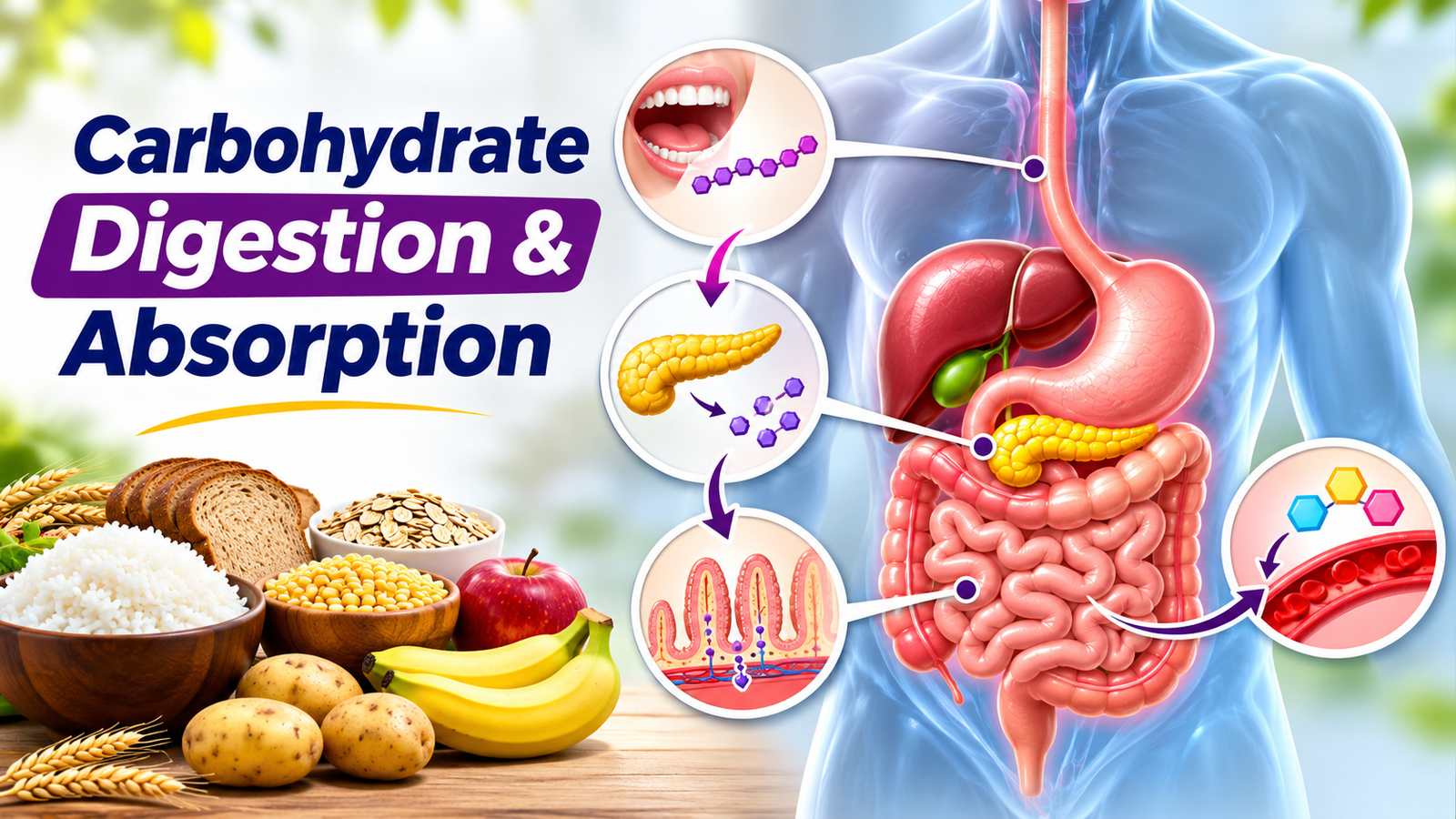
Carbohydrate digestion is the process through which complex carbohydrates and disaccharides are broken down into smaller sugar molecules that can be absorbed through the intestinal lining.
The main purpose of carbohydrate digestion is to convert digestible carbohydrates into absorbable monosaccharides.
Carbohydrate digestion involves several organs and enzymes:
Mouth
Oesophagus
Stomach
Pancreas
Small intestine
Most carbohydrate digestion takes place in the small intestine, although the process begins in the mouth.
3. Stages of Carbohydrate Digestion
Stage 1: Carbohydrate Digestion in the Mouth
Carbohydrate digestion begins in the mouth.
When carbohydrate-containing foods such as rice, bread, roti or potatoes are eaten, the teeth break them into smaller particles through chewing, a process known as mastication.
Chewing helps:
Reduce food particle size.
Mix food with saliva.
Make swallowing easier.
Increase the surface area available for digestive enzymes.
Saliva contains an important digestive enzyme called salivary amylase, also known as ptyalin.
Role of salivary amylase
Salivary amylase begins the digestion of starch.
It breaks certain internal alpha-1,4 glycosidic bonds in starch molecules, producing smaller carbohydrate fragments, including:
Maltose
Maltotriose
Shorter dextrins
Salivary amylase does not completely digest starch into glucose.
Its activity is most effective near a neutral pH.
For example, when rice or bread is chewed for some time, starch digestion begins through the action of salivary amylase.
The partially digested food mixes with saliva to form a soft mass called a bolus.
The bolus is then swallowed and moves towards the stomach.
Stage 2: Movement Through the Oesophagus
The oesophagus is a muscular tube connecting the mouth to the stomach.
After swallowing, coordinated muscular contractions called peristalsis push the food bolus towards the stomach.
The oesophagus mainly transports food and does not play a significant role in carbohydrate digestion.
Stage 3: Carbohydrate Digestion in the Stomach
The stomach receives food from the oesophagus and mixes it with gastric juice.
Gastric juice contains:
Hydrochloric acid.
Pepsinogen.
Gastric mucus.
Other substances involved in digestion.
Unlike the mouth and small intestine, the stomach does not secrete a major carbohydrate-digesting enzyme.
Salivary amylase may continue working briefly inside the swallowed food until the acidic stomach environment inactivates it.
As the food mixes with gastric acid, salivary amylase activity gradually decreases.
The stomach also performs mechanical digestion by churning food and mixing it with gastric secretions.
This produces a semi-liquid mixture called chyme.
The chyme gradually passes through the pyloric sphincter into the duodenum, the first part of the small intestine.
Stage 4: Carbohydrate Digestion in the Small Intestine
The small intestine is the major site of carbohydrate digestion and absorption.
When acidic chyme enters the duodenum, it stimulates the release of digestive hormones.
Two important hormones involved in coordinating digestion are:
Secretin
Secretin stimulates the pancreas to release bicarbonate-rich fluid.
Bicarbonate helps neutralise the acidic chyme entering the small intestine from the stomach.
This creates a more suitable environment for pancreatic digestive enzymes.
Cholecystokinin (CCK)
CCK helps coordinate digestive secretions and stimulates pancreatic enzyme release.
Although CCK is particularly important for coordinating fat and protein digestion, it also contributes to the overall digestive response after a meal.
Role of Pancreatic Amylase
The pancreas releases pancreatic amylase into the duodenum.
Pancreatic amylase is the major enzyme responsible for digesting dietary starch in the small intestine.
It breaks alpha-1,4 glycosidic bonds in starch molecules, producing smaller carbohydrates such as:
Maltose
Maltotriose
Alpha-limit dextrins
However, pancreatic amylase cannot completely digest all carbohydrate structures.
The remaining smaller carbohydrate molecules require the action of enzymes present on the intestinal brush border.
4. Brush Border Enzymes Involved in Carbohydrate Digestion
The inner surface of the small intestine contains numerous finger-like projections called villi.
The epithelial cells covering these villi have smaller microscopic projections called microvilli.
Together, these structures form the brush border.
The brush border increases the surface area available for digestion and nutrient absorption.
Several important carbohydrate-digesting enzymes are located on the brush border of intestinal epithelial cells.
4.1 Maltase
Maltase breaks down maltose into two glucose molecules.
Maltose is produced during the digestion of starch.
The glucose molecules released by maltase can then be absorbed by intestinal cells.
4.2 Sucrase
Sucrase breaks down sucrose into:
Glucose
Fructose
Sucrose is commonly known as table sugar and is naturally present in many fruits and vegetables.
After digestion, glucose and fructose can be absorbed through different intestinal transport systems.
4.3 Lactase
Lactase breaks down lactose into:
Glucose
Galactose
Lactose is the natural sugar present in milk and many dairy products.
People with insufficient lactase activity may experience lactose intolerance symptoms after consuming lactose-containing foods.
These symptoms may include:
Bloating.
Gas.
Abdominal discomfort.
Diarrhoea.
4.4 Isomaltase
Isomaltase helps break alpha-1,6 glycosidic bonds present in branched starch digestion products.
It works as part of the sucrase-isomaltase enzyme complex.
This enzyme is important for completing the digestion of branched carbohydrate fragments.
4.5 Glucoamylase
Glucoamylase is another brush-border enzyme that helps break smaller carbohydrate chains into glucose molecules.
Together, these enzymes complete the digestion of most digestible dietary carbohydrates.
The final absorbable products are mainly:
Glucose
Galactose
Fructose
5. What Is Carbohydrate Absorption?
Carbohydrate absorption is the process through which the monosaccharides produced during digestion cross the intestinal lining and enter the circulation.
Most carbohydrate absorption occurs in the small intestine, particularly the jejunum.
The intestinal epithelial cells responsible for absorption are called enterocytes.
The three main monosaccharides absorbed from the intestine are:
Glucose
Galactose
Fructose
Different transport proteins are responsible for absorbing these sugars.
6. Mechanism of Glucose Absorption
Glucose absorption mainly occurs through a transporter called sodium-glucose cotransporter 1 (SGLT1).
SGLT1 is located on the apical membrane of intestinal epithelial cells, which faces the intestinal lumen.
It transports glucose into the enterocyte together with sodium ions.
This process is known as secondary active transport.
The sodium gradient required for SGLT1 activity is maintained by the sodium-potassium ATPase pump located on the basolateral membrane of the intestinal cell.
The sodium-potassium pump uses energy from ATP to move sodium out of the cell and potassium into the cell.
This maintains a low intracellular sodium concentration, allowing sodium and glucose to enter through SGLT1.
Once inside the enterocyte, glucose moves across the basolateral membrane through a transporter called GLUT2.
It then enters the blood circulation.
7. Mechanism of Galactose Absorption
Galactose is produced during the digestion of lactose.
It is absorbed through the same primary intestinal transport system used by glucose.
SGLT1 transports galactose into intestinal epithelial cells along with sodium ions.
After entering the enterocyte, galactose moves through the basolateral membrane, mainly through GLUT2, into the bloodstream.
Galactose is then transported to the liver, where it can be converted into glucose-related metabolic intermediates.
8. Mechanism of Fructose Absorption
Fructose is absorbed through a different transport mechanism.
It mainly enters intestinal epithelial cells through a transporter called GLUT5.
Unlike glucose and galactose absorption through SGLT1, fructose absorption through GLUT5 occurs by facilitated diffusion and does not directly require sodium.
After entering the enterocyte, fructose exits through the basolateral membrane, mainly through GLUT2, and enters the blood circulation.
The liver plays an important role in fructose metabolism.
9. How Do Absorbed Monosaccharides Reach Different Body Tissues?
After passing through the intestinal epithelial cells, absorbed monosaccharides enter the blood vessels within the intestinal villi.
They are transported through the hepatic portal vein to the liver.
The liver is a major organ involved in carbohydrate metabolism.
It helps regulate blood glucose levels by:
Taking up glucose from the blood.
Storing glucose as glycogen.
Releasing glucose when required.
Converting certain sugars into metabolic intermediates.
Participating in glucose production during fasting.
After processing by the liver, glucose enters the general circulation and becomes available to other tissues.
Important glucose-using tissues include:
Brain.
Skeletal muscles.
Red blood cells.
Kidneys.
Adipose tissue.
Other body organs.
Different tissues use glucose in different ways depending on their energy requirements and hormonal regulation.
10. What Happens to Glucose After Absorption?
After absorption, glucose can follow several metabolic pathways.
10.1 Glucose Oxidation for Energy
Glucose is an important source of energy.
Through a process called cellular respiration, glucose is broken down to produce ATP (adenosine triphosphate).
ATP is the main energy currency of cells.
The major stages of glucose oxidation include:
Glycolysis.
Pyruvate oxidation.
Citric acid cycle.
Electron transport chain and oxidative phosphorylation.
Under aerobic conditions, these processes allow cells to extract energy from glucose.
10.2 Glycogenesis
When glucose availability is high, the body can store some of it as glycogen.
The process of converting glucose into glycogen is called glycogenesis.
Glycogen is stored mainly in:
Liver.
Skeletal muscles.
Liver glycogen helps maintain blood glucose levels between meals.
Muscle glycogen provides a readily available energy source for muscle activity.
10.3 Glycogenolysis
When the body requires additional glucose or energy, glycogen can be broken down.
This process is called glycogenolysis.
In the liver, glycogen breakdown helps maintain blood glucose levels.
In skeletal muscle, glycogen breakdown supplies glucose-6-phosphate for energy production within muscle cells.
10.4 Glycolysis
Glycolysis is the metabolic pathway through which glucose is converted into pyruvate.
It occurs in the cytoplasm of cells.
Glycolysis produces ATP and NADH.
When oxygen availability and cellular conditions support aerobic metabolism, pyruvate can enter the mitochondria and undergo further oxidation.
When oxygen availability is limited, or in cells without mitochondria, pyruvate may be converted into lactate.
10.5 Lipogenesis
When energy intake consistently exceeds energy requirements, excess carbohydrate-derived energy can contribute to fat storage.
The liver can convert excess carbohydrate-derived carbon into fatty acids through a process called de novo lipogenesis.
These fatty acids can be incorporated into triglycerides and stored in adipose tissue.
However, body fat accumulation is influenced by overall energy balance, dietary intake, physical activity, and metabolic regulation rather than carbohydrate intake alone.
11. Role of Insulin in Carbohydrate Metabolism
Insulin is a hormone produced by the beta cells of the pancreas.
After carbohydrate-containing foods are consumed and blood glucose levels rise, insulin secretion generally increases.
Insulin helps regulate blood glucose levels by supporting glucose uptake and storage.
Its major functions include:
Increasing glucose uptake in skeletal muscle and adipose tissue.
Supporting glycogen synthesis.
Promoting the storage of excess energy.
Reducing glucose production by the liver.
Supporting normal nutrient metabolism.
In skeletal muscle and adipose tissue, insulin stimulates the movement of GLUT4 transporters to the cell membrane.
GLUT4 allows glucose to enter these cells.
The liver uses a different glucose transporter, GLUT2, and its glucose uptake is not directly dependent on insulin in the same way as GLUT4-mediated uptake.
Insulin nevertheless plays an important role in regulating liver glucose metabolism.
12. Role of Dietary Fibre in Carbohydrate Digestion
Dietary fibre is a type of carbohydrate that is not completely digested by human digestive enzymes.
It is naturally present in plant foods such as:
Fruits.
Vegetables.
Whole grains.
Pulses.
Nuts.
Seeds.
Dietary fibre is broadly classified into soluble and insoluble fibre.
12.1 Soluble Fibre
Soluble fibre dissolves in water and may form a gel-like substance in the digestive tract.
Examples include:
Oats.
Barley.
Beans.
Lentils.
Apples.
Citrus fruits.
Psyllium.
Some soluble fibres can slow gastric emptying or carbohydrate absorption, which may help moderate the rise in blood glucose after meals.
12.2 Insoluble Fibre
Insoluble fibre does not dissolve in water.
It helps add bulk to stool and supports normal bowel movements.
Sources include:
Whole wheat.
Wheat bran.
Vegetable skins.
Nuts.
Seeds.
Some whole grains.
12.3 Fermentation of Dietary Fibre
Certain fibres reach the large intestine, where gut microorganisms ferment them.
This process produces short-chain fatty acids, including:
Acetate.
Propionate.
Butyrate.
Short-chain fatty acids support intestinal health and provide energy to colon cells.
12.4 Resistant Starch
Resistant starch is a type of starch that escapes digestion in the small intestine and reaches the large intestine.
It can be fermented by gut bacteria.
Sources include:
Legumes.
Green bananas.
Some whole grains.
Cooked and cooled potatoes.
Cooked and cooled rice.
The amount of resistant starch can vary with food variety, preparation and storage conditions.
13. Factors Affecting Carbohydrate Digestion and Absorption
Carbohydrate digestion and absorption are influenced by several factors.
13.1 Type of Carbohydrate
Different carbohydrates have different digestion and absorption characteristics.
For example:
Glucose is directly absorbed.
Sucrose requires sucrase activity.
Lactose requires lactase activity.
Starch requires amylase and brush-border enzymes.
Fibre is not completely digested by human enzymes.
Therefore, the type of carbohydrate consumed affects how quickly it is digested and absorbed.
13.2 Food Structure and Processing
The physical structure of food can influence carbohydrate digestion.
Whole grains, intact legumes and minimally processed foods may require more digestive breakdown than finely processed carbohydrate foods.
Grinding, milling and cooking can alter the accessibility of starch to digestive enzymes.
For example, finely milled flour may be digested differently from intact whole grains.
13.3 Cooking Methods
Cooking generally makes many starch-containing foods easier to digest by gelatinising starch.
However, cooling cooked starch-containing foods may increase the amount of resistant starch through a process called retrogradation.
Examples include some cooked and cooled rice and potatoes.
The amount formed depends on cooking, cooling, storage and reheating conditions.
13.4 Dietary Fibre Content
Fibre can influence the rate of digestion and absorption.
Certain soluble fibres increase the viscosity of intestinal contents and may slow glucose absorption.
Meals containing fibre-rich vegetables, pulses and whole grains may produce a different post-meal glucose response from meals containing mostly refined carbohydrates.
13.5 Presence of Fat and Protein in a Meal
The combination of macronutrients in a meal can influence gastric emptying and the timing of glucose absorption.
Meals containing fat and protein may slow gastric emptying and change the post-meal blood glucose response.
However, the overall effect depends on meal composition, portion size and individual metabolic health.
13.6 Digestive Enzyme Activity
Normal carbohydrate digestion depends on the activity of salivary amylase, pancreatic amylase and intestinal brush-border enzymes.
Reduced enzyme activity may interfere with digestion.
For example, low lactase activity can lead to lactose malabsorption.
13.7 Gut Health
The small intestine is the major site of carbohydrate digestion and absorption.
Conditions that damage the intestinal lining may affect nutrient absorption.
Examples include:
Coeliac disease.
Inflammatory bowel disease.
Certain intestinal infections.
Short bowel syndrome.
13.8 Hormonal and Metabolic Factors
Hormones such as insulin and glucagon help regulate blood glucose levels after absorption.
Insulin supports glucose uptake in muscle and adipose tissue, while glucagon helps maintain blood glucose during fasting by stimulating processes such as hepatic glycogenolysis and gluconeogenesis.
Insulin resistance and diabetes can affect how the body regulates blood glucose after carbohydrate consumption.
14. Carbohydrate Digestion in Common Health Conditions
Certain health conditions can affect carbohydrate digestion, absorption or metabolism.
14.1 Lactose Intolerance
Lactose intolerance occurs when the small intestine has insufficient lactase activity to digest lactose adequately.
Undigested lactose reaches the large intestine, where gut bacteria ferment it.
This can produce:
Bloating.
Gas.
Abdominal pain.
Diarrhoea.
Management may include adjusting lactose intake, using lactose-free dairy products or consuming lactase enzyme products when appropriate.
Lactose intolerance is different from milk allergy.
14.2 Diabetes Mellitus
Diabetes mellitus is a metabolic condition characterised by elevated blood glucose levels due to problems with insulin production, insulin action or both.
Carbohydrate digestion and absorption still occur, but glucose regulation is impaired.
Nutrition management may include:
Monitoring carbohydrate intake.
Choosing fibre-rich carbohydrate foods.
Considering portion sizes.
Spreading carbohydrate intake across meals.
Combining carbohydrate foods with protein and healthy fats.
Individualising meal plans according to medication and blood glucose response.
People with diabetes should receive personalised advice from qualified healthcare professionals.
14.3 Coeliac Disease
Coeliac disease is an autoimmune condition triggered by gluten in genetically susceptible individuals.
It damages the small intestinal lining and may impair nutrient absorption.
Although gluten is a protein rather than a carbohydrate, foods containing gluten often provide carbohydrate as well. Damage to the intestine can therefore affect the absorption of several nutrients.
A strict medically supervised gluten-free diet is the main treatment.
14.4 Pancreatic Insufficiency
The pancreas produces pancreatic amylase, which contributes to starch digestion.
Pancreatic exocrine insufficiency may reduce digestive enzyme availability and contribute to maldigestion.
The clinical effect depends on the underlying condition and severity.
14.5 Irritable Bowel Syndrome and FODMAPs
Some people with irritable bowel syndrome (IBS) experience digestive symptoms after consuming certain fermentable carbohydrates known as FODMAPs.
These include:
Fermentable oligosaccharides.
Disaccharides.
Monosaccharides.
Polyols.
Examples include lactose, excess fructose, certain wheat carbohydrates, onions, garlic and some legumes.
In susceptible individuals, these carbohydrates may contribute to bloating, abdominal pain and altered bowel habits.
A low-FODMAP diet may be recommended for selected individuals under dietitian guidance. It is generally used as a structured, time-limited approach followed by food reintroduction, rather than as a permanent restrictive diet.
15. Signs of Carbohydrate Malabsorption
Carbohydrate malabsorption occurs when certain carbohydrates are not adequately digested or absorbed in the small intestine.
Possible symptoms include:
Abdominal bloating.
Excessive gas.
Abdominal discomfort.
Diarrhoea.
Loose stools.
Increased intestinal sounds.
Symptoms depend on the type and amount of carbohydrate consumed and individual digestive tolerance.
Persistent symptoms should be assessed by a healthcare professional rather than managed through unnecessary long-term food restrictions.
16. Practical Tips for Healthy Carbohydrate Digestion
For generally healthy individuals, the following habits can support good digestive and metabolic health:
Include whole grains such as oats, whole wheat and millets.
Consume pulses and legumes regularly.
Include fruits and vegetables in daily meals.
Choose high-fibre foods more often than highly refined carbohydrate foods.
Chew food properly.
Cook beans and pulses adequately.
Maintain adequate hydration.
Avoid excessive intake of sugar-sweetened beverages.
Maintain regular physical activity.
Seek medical advice for persistent digestive symptoms.
Carbohydrates should not be eliminated unnecessarily. The body can obtain useful nutrients and dietary fibre from a variety of carbohydrate-containing foods.
17. Frequently Asked Questions (FAQs)
1. Where does carbohydrate digestion begin?
Carbohydrate digestion begins in the mouth through the action of salivary amylase, which starts breaking down starch.
2. Which enzyme digests carbohydrates in the mouth?
Salivary amylase, also called ptyalin, begins starch digestion in the mouth.
3. Does carbohydrate digestion occur in the stomach?
There is no major carbohydrate-digesting enzyme secreted by the stomach. Salivary amylase may continue working briefly until the acidic stomach environment inactivates it.
4. Where does most carbohydrate digestion occur?
Most carbohydrate digestion occurs in the small intestine through pancreatic amylase and intestinal brush-border enzymes.
5. Which enzyme breaks down starch?
Salivary amylase and pancreatic amylase break down starch into smaller carbohydrate fragments. Brush-border enzymes complete the process.
6. Which enzyme digests lactose?
Lactase breaks lactose into glucose and galactose.
7. Which enzyme breaks down sucrose?
Sucrase breaks sucrose into glucose and fructose.
8. What are the final products of carbohydrate digestion?
The main absorbable products are glucose, galactose, and fructose.
9. Where does glucose absorption occur?
Glucose is mainly absorbed in the small intestine through a transporter called SGLT1.
10. What is the role of GLUT5?
GLUT5 is a transporter that helps absorb fructose into intestinal epithelial cells.
11. What is the role of insulin after carbohydrate absorption?
Insulin helps regulate blood glucose levels and promotes glucose uptake in skeletal muscle and adipose tissue through GLUT4 transporters.
12. What happens to excess glucose?
Glucose can be stored as glycogen in the liver and muscles. When energy intake consistently exceeds energy needs, excess carbohydrate-derived energy may also contribute to fat storage.
13. Is dietary fibre digested like starch?
No. Human digestive enzymes cannot completely digest most dietary fibre. Some fibres are fermented by gut bacteria in the large intestine.
14. Why do some people experience bloating after milk consumption?
People with lactose intolerance have insufficient lactase activity to digest lactose adequately. Undigested lactose can be fermented by intestinal bacteria, producing gas and other symptoms.
15. Does cooking affect carbohydrate digestion?
Yes. Cooking can gelatinise starch and make it more accessible to digestive enzymes. Cooling some cooked starch-containing foods may increase resistant starch.
Conclusion
Carbohydrate digestion and absorption are essential processes that allow the body to obtain energy from dietary carbohydrates.
Digestion begins in the mouth through salivary amylase and continues in the small intestine through pancreatic amylase and brush-border enzymes such as maltase, sucrase, lactase and isomaltase.
The final products of digestible carbohydrate breakdown are mainly glucose, galactose and fructose. These monosaccharides are absorbed through specialised transport proteins in intestinal epithelial cells and transported through the hepatic portal vein to the liver.
After absorption, glucose can be used to produce ATP, stored as glycogen or contribute to other metabolic pathways. Insulin plays an important role in regulating blood glucose levels and supporting glucose uptake in muscle and adipose tissue.
Dietary fibre also plays an important role in digestive health. Although it is not completely digested by human enzymes, it supports bowel function and provides substrates for beneficial gut bacteria.
A balanced diet containing whole grains, pulses, fruits, vegetables and other nutrient-rich foods can support healthy carbohydrate digestion, absorption and metabolism.
References
Hall JE. Guyton and Hall Textbook of Medical Physiology. Elsevier.
Barrett KE et al. Ganong's Review of Medical Physiology. McGraw Hill.
National Institute of Diabetes and Digestive and Kidney Diseases (NIDDK). Your Digestive System and How It Works.
National Center for Biotechnology Information. Physiology, Carbohydrate Digestion and Absorption. StatPearls.
National Institutes of Health. Dietary Fiber: Essential for a Healthy Diet.
World Health Organization. Carbohydrate Intake for Adults and Children: WHO Guideline, 2023.
Medical Disclaimer: This article is intended for general educational purposes and should not replace individual medical advice, diagnosis, or treatment. People with diabetes, coeliac disease, lactose intolerance or persistent digestive symptoms should consult a qualified healthcare professional for personalised dietary guidance.







💬 Comments (0)
Be respectful. Website links and phone numbers are not allowed.