

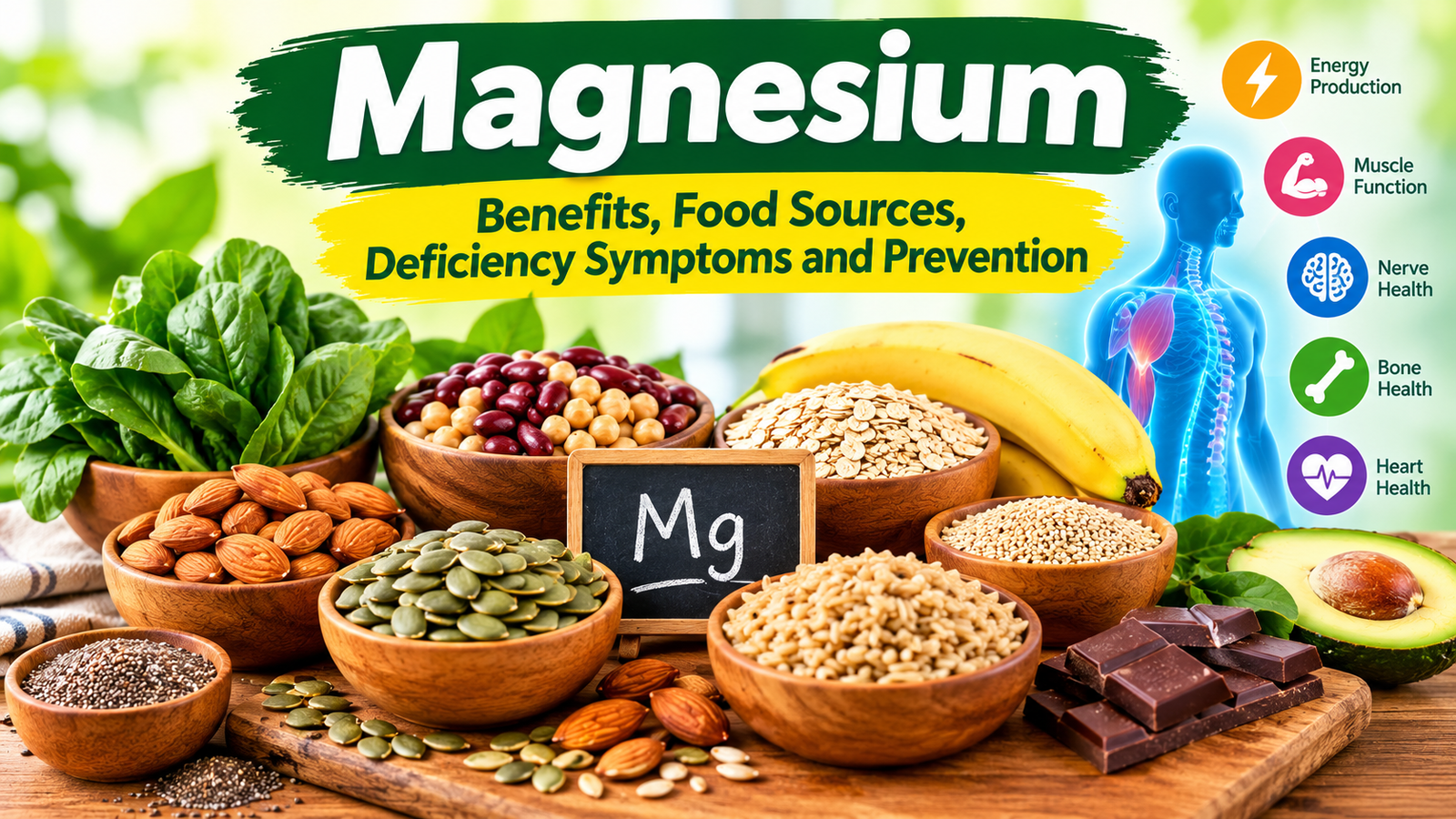
Magnesium is an essential micromineral that plays an important role in energy production, muscle function, nerve transmission, bone health, blood glucose regulation and hundreds of enzymatic reactions in the human body.
It is involved in more than 300 enzyme systems that regulate important physiological processes, including protein synthesis, DNA formation, muscle contraction and cellular energy metabolism.
Despite its importance, magnesium intake may be inadequate in people who consume highly refined foods, have limited dietary diversity or suffer from certain digestive and metabolic disorders.
In India, magnesium can be obtained from everyday foods such as green leafy vegetables, whole grains, millets, pulses, nuts, seeds and legumes.
Understanding magnesium's functions, dietary sources, daily requirements, deficiency symptoms and factors affecting absorption can help individuals maintain better nutritional health.
This article explains everything about magnesium, including its benefits, Indian food sources, recommended intake, deficiency, excess intake and practical dietary strategies.
1. What Is Magnesium?
Magnesium is an essential mineral required for normal cellular and physiological functioning.
It is the fourth most abundant mineral in the human body after calcium, sodium and potassium.
Approximately 50â60% of total body magnesium is present in bones, while most of the remaining amount is located inside cells and soft tissues. Only a very small proportion circulates in the blood.
Magnesium participates in several important biological activities, including:
ATP production and energy metabolism.
Protein synthesis.
DNA and RNA formation.
Muscle contraction and relaxation.
Nerve impulse transmission.
Blood glucose regulation.
Blood pressure regulation.
Bone mineral metabolism.
Normal heart rhythm.
The human body cannot produce magnesium. Therefore, it must be obtained through dietary sources or supplements when medically necessary.
2. Health Benefits of Magnesium
2.1 Supports Energy Production
One of the most important functions of magnesium is its involvement in energy metabolism.
Magnesium binds to ATP (adenosine triphosphate), forming magnesium-ATP complexes that are required for many enzyme reactions.
ATP is the primary energy-carrying molecule in cells.
Magnesium-dependent reactions support:
Carbohydrate metabolism.
Fat metabolism.
Protein synthesis.
Cellular energy production.
Muscle activity.
Inadequate magnesium availability can interfere with normal cellular metabolism.
2.2 Supports Muscle Contraction and Relaxation
Magnesium plays an important role in normal muscle function.
Calcium helps initiate muscle contraction, while magnesium participates in regulating muscle relaxation and calcium movement within muscle cells.
Adequate magnesium is important for:
Normal muscle contraction.
Muscle relaxation.
Physical performance.
Neuromuscular coordination.
Normal muscle metabolism.
Severe magnesium deficiency can cause muscle cramps, tremors, spasms and weakness.
However, ordinary muscle cramps are not necessarily caused by magnesium deficiency. Dehydration, fatigue, other electrolyte disturbances and medical conditions can also contribute.
2.3 Supports Normal Nerve Function
Magnesium helps regulate nerve transmission and communication between nerve cells.
It influences ion channels and participates in the regulation of neurotransmitter activity.
Magnesium is important for:
Normal nerve signaling.
Neuromuscular coordination.
Cellular electrical activity.
Normal nervous system function.
Severe deficiency may cause tingling, numbness, tremors and increased neuromuscular excitability.
2.4 Supports Bone Health
Approximately half to three-fifths of total body magnesium is stored in bones.
Magnesium contributes to bone structure and mineral metabolism.
It is involved in:
Bone formation.
Osteoblast and osteoclast activity.
Calcium regulation.
Vitamin D metabolism.
Normal bone mineralization.
Magnesium works alongside calcium, phosphorus and vitamin D to support skeletal health.
Adequate magnesium intake is particularly important during growth, adulthood and ageing.
2.5 Supports Heart Function
Magnesium contributes to normal electrical activity in the heart.
It helps regulate the movement of calcium and potassium across cell membranes, which is important for maintaining normal cardiac electrical activity.
Adequate magnesium supports:
Normal heart rhythm.
Cardiac muscle function.
Electrolyte balance.
Normal vascular function.
Severe magnesium deficiency may cause abnormal heart rhythms, which can become medically serious.
2.6 Helps Regulate Blood Pressure
Magnesium participates in vascular smooth muscle function and the regulation of blood vessel tone.
Adequate magnesium intake has been associated with healthy blood pressure regulation.
Some studies suggest that magnesium supplementation may produce modest reductions in blood pressure, particularly in people with inadequate intake or hypertension.
However, magnesium supplements should not replace prescribed blood pressure medication.
2.7 Supports Blood Glucose Regulation
Magnesium is involved in insulin signaling and glucose metabolism.
It contributes to several enzymatic reactions involved in carbohydrate metabolism.
Inadequate magnesium status has been associated with insulin resistance and a higher risk of developing type 2 diabetes in observational studies.
Maintaining adequate magnesium intake through a balanced diet is beneficial for overall metabolic health.
However, magnesium supplements are not a substitute for diabetes treatment.
2.8 Supports Protein Synthesis
Magnesium participates in ribosomal activity and protein synthesis.
It is required for several processes involved in building and maintaining body proteins.
Protein synthesis is essential for:
Muscle maintenance.
Tissue repair.
Growth and development.
Enzyme production.
Cellular regeneration.
2.9 Supports DNA and RNA Formation
Magnesium acts as a cofactor for enzymes involved in DNA and RNA synthesis.
It supports genetic material formation, cellular division and normal tissue development.
This makes magnesium essential for growth, repair and maintenance of body cells.
2.10 Supports Immune Function
Magnesium participates in several cellular processes involved in immune system functioning.
It contributes to normal immune cell activity, inflammatory regulation and cellular signaling.
Adequate magnesium intake is therefore part of maintaining overall nutritional health.
3. Recommended Daily Magnesium Requirement
Magnesium requirements vary according to age, sex, physiological condition and national dietary recommendations.
According to ICMR-NIN's 2020 recommendations, adult magnesium requirements in India are approximately:
| Population group | Daily magnesium requirement |
|---|---|
| Adult men | 440 mg |
| Adult women | 370 mg |
| Pregnant women | 440 mg |
| Lactating women | 400 mg |
These are the ICMR-NIN reference values for Indian dietary planning.
Why Is Magnesium Important During Pregnancy?
Magnesium supports several physiological processes during pregnancy, including:
Maternal energy metabolism.
Normal muscle and nerve function.
Protein synthesis.
Bone metabolism.
Cellular growth and development.
Pregnant women should obtain magnesium through a balanced diet and follow professional advice regarding supplements.
Why Is Magnesium Important During Adolescence?
Adolescence is a period of rapid physical growth.
Magnesium supports bone development, energy metabolism, muscle function and protein synthesis.
A balanced diet containing whole grains, pulses, nuts, seeds and green vegetables can help meet magnesium requirements.
4. Best Magnesium-Rich Foods in India
A balanced Indian diet can provide magnesium through plant-based and animal-based foods.
Green leafy vegetables, whole grains, pulses, nuts and seeds are particularly useful sources.
A. Nuts and Seeds
Nuts and seeds are among the most concentrated dietary sources of magnesium.
| Food | Approximate magnesium per 100 g |
|---|---|
| Pumpkin seeds | 530-550 mg |
| Sesame seeds | 340-360 mg |
| Almonds | 260-280 mg |
| Cashew nuts | 260-300 mg |
| Peanuts | 160-180 mg |
| Sunflower seeds | 320-330 mg |
| Flaxseeds | 380-400 mg |
| Chia seeds | 330-340 mg |
How to include them in an Indian diet:
Add pumpkin seeds to salads.
Include almonds as a snack.
Prepare sesame seed chutney.
Add ground flaxseeds to curd.
Use peanuts in poha and upma.
Add chia seeds to homemade smoothies.
Nuts and seeds are energy-dense, so portion sizes should be considered.
B. Green Leafy Vegetables
Green leafy vegetables are valuable sources of magnesium.
Magnesium is present at the centre of the chlorophyll molecule, which gives plants their green colour.
| Vegetable | Approximate magnesium per 100 g |
|---|---|
| Spinach | 75-80 mg |
| Amaranth leaves | 50-60 mg |
| Fenugreek leaves | 45-50 mg |
| Coriander leaves | 25-30 mg |
| Mustard greens | 30-35 mg |
Practical Indian preparations include:
Palak dal.
Methi paratha.
Amaranth vegetable curry.
Spinach soup.
Mixed green vegetable sabzi.
Including different green vegetables helps improve overall micronutrient intake.
C. Pulses and Legumes
Pulses and legumes provide magnesium along with protein, fibre, iron and other minerals.
| Food | Approximate magnesium per 100 g dry |
|---|---|
| Soybeans | 270-290 mg |
| Black chickpeas | 150-170 mg |
| Chickpeas | 110-120 mg |
| Rajma | 130-140 mg |
| Green gram | 170-190 mg |
| Lentils | 40-50 mg |
Indian meal options include:
Moong dal.
Chana masala.
Rajma curry.
Masoor dal.
Sprouted green gram.
Soybean curry.
Soaking, germination and cooking improve digestibility and can reduce some antinutritional compounds.
D. Whole Grains and Millets
Whole grains and millets contribute magnesium to the Indian diet.
Magnesium is concentrated in the bran and germ of cereal grains. Refining grains can remove some of these nutrient-rich components.
| Food | Approximate magnesium per 100 g dry |
|---|---|
| Oats | 170-180 mg |
| Brown rice | 140-150 mg |
| Whole wheat | 130-140 mg |
| Bajra | 130-140 mg |
| Ragi | 130-140 mg |
| Jowar | 130-140 mg |
Useful meal options include:
Ragi dosa.
Bajra roti.
Jowar bhakri.
Oats porridge.
Whole wheat roti.
Brown rice.
Choosing whole grains more frequently instead of highly refined cereals can improve dietary magnesium intake.
E. Fruits
Some fruits provide magnesium, although they generally contain less magnesium than nuts, seeds and whole grains.
| Fruit | Approximate magnesium per 100 g |
|---|---|
| Banana | 25-30 mg |
| Avocado | 25-30 mg |
| Papaya | 20-22 mg |
| Guava | 20-25 mg |
| Jackfruit | 25-30 mg |
Fruits can contribute to daily magnesium intake while providing fibre, potassium and vitamins.
F. Other Food Sources
Additional dietary sources include:
| Food | Approximate magnesium per 100 g |
|---|---|
| Dark chocolate | 200-230 mg |
| Tofu | 25-60 mg |
| Plain curd | 10-15 mg |
| Milk | 10-12 mg |
| Cooked fish | 25-35 mg |
| Egg | 10-15 mg |
Magnesium content varies depending on food variety, preparation and processing. Values are approximate and should not be treated as exact laboratory measurements.
5. Magnesium Deficiency: Causes and Risk Factors
Magnesium deficiency is known medically as hypomagnesaemia when blood magnesium levels become abnormally low.
Severe symptomatic magnesium deficiency is relatively uncommon in otherwise healthy people because the kidneys help regulate magnesium balance.
However, prolonged inadequate intake, gastrointestinal losses, kidney-related problems and certain medications can increase deficiency risk.
Common Causes of Magnesium Deficiency
1. Inadequate dietary intake
People who consume highly refined cereals, processed foods and very few nuts, seeds, pulses or vegetables may have inadequate magnesium intake.
2. Chronic diarrhoea
Prolonged diarrhoea can increase magnesium loss through the digestive tract.
3. Digestive disorders
Conditions such as coeliac disease, Crohn's disease and other malabsorption disorders may reduce magnesium absorption.
4. Chronic alcohol misuse
Long-term excessive alcohol consumption can contribute to poor dietary intake, gastrointestinal disturbances and increased urinary magnesium loss.
5. Type 2 diabetes
Poorly controlled diabetes can increase urinary magnesium loss due to glucose-related osmotic diuresis.
6. Kidney-related conditions
Certain kidney disorders can increase magnesium loss through urine.
7. Certain medications
Some medicines can affect magnesium balance, including:
Certain diuretics.
Long-term proton pump inhibitor use.
Some antibiotics.
Certain chemotherapy medicines.
People taking long-term medication should not stop treatment independently. A healthcare professional can assess whether magnesium monitoring is necessary.
8. Older age
Older adults may have increased risk due to changes in dietary intake, gastrointestinal absorption, kidney function and medication use.
6. Symptoms of Magnesium Deficiency
Symptoms depend on the severity and duration of deficiency.
Mild magnesium deficiency may not cause obvious symptoms initially.
6.1 Fatigue and Weakness
Magnesium is essential for ATP-related energy metabolism.
Low magnesium levels can affect normal muscle and cellular function, contributing to fatigue and weakness.
6.2 Muscle Cramps
Magnesium participates in neuromuscular regulation.
Significant deficiency may increase neuromuscular excitability and contribute to muscle cramps or spasms.
However, muscle cramps alone do not confirm magnesium deficiency.
6.3 Loss of Appetite
Reduced appetite can occur in people with magnesium deficiency.
It may also be associated with nausea and digestive discomfort.
6.4 Nausea and Vomiting
Some people with magnesium deficiency may experience nausea and vomiting.
These symptoms are nonspecific and can occur in many other health conditions.
6.5 Tingling and Numbness
More significant magnesium deficiency may cause tingling sensations, numbness and abnormal nerve activity.
6.6 Tremors and Muscle Spasms
Severe magnesium deficiency can affect nerve and muscle excitability, leading to tremors, involuntary contractions and muscle spasms.
6.7 Abnormal Heart Rhythm
Magnesium contributes to normal electrical activity in the heart.
Severe deficiency can cause abnormal heart rhythms, which may require urgent medical attention.
6.8 Seizures
In extreme cases, severe magnesium deficiency can affect nervous system functioning and contribute to seizures.
6.9 Associated Calcium and Potassium Deficiency
Severe magnesium deficiency can disturb calcium and potassium balance.
It may cause:
Hypocalcemia (low blood calcium).
Hypokalemia (low blood potassium).
These electrolyte disturbances can worsen muscle weakness and cardiac problems.
Important: Magnesium deficiency cannot be diagnosed from symptoms alone. Blood testing and medical assessment are required.
7. Factors Affecting Magnesium Absorption
Magnesium absorption depends on dietary composition, digestive health, physiological conditions and the amount consumed.
Understanding these factors can help improve magnesium intake and utilization.
7.1 Phytates
Phytates are naturally occurring compounds found in many plant foods.
They can bind certain minerals, including magnesium, and reduce their absorption.
Common phytate-containing foods include:
Whole wheat.
Bajra.
Ragi.
Chickpeas.
Rajma.
Soybeans.
Nuts.
Seeds.
However, these foods are also valuable sources of magnesium.
Soaking, germination, fermentation and appropriate cooking may reduce some phytates and improve mineral bioavailability.
7.2 High Dietary Fibre
Magnesium-rich foods often contain dietary fibre.
Some types of fibre and associated food components can influence mineral absorption.
However, whole grains, fruits, vegetables and legumes should not be avoided because they are important sources of magnesium and other essential nutrients.
7.3 Gastrointestinal Health
The small intestine is the primary site of magnesium absorption.
Digestive disorders that cause chronic diarrhoea, intestinal inflammation or malabsorption can reduce magnesium availability.
Examples include:
Coeliac disease.
Crohn's disease.
Chronic inflammatory bowel conditions.
Certain intestinal surgeries.
7.4 Kidney Function
The kidneys play an important role in maintaining magnesium balance.
They regulate magnesium excretion through urine.
Certain kidney disorders and medications may increase urinary magnesium loss.
7.5 Age
Magnesium absorption and retention can change with ageing.
Older adults may also consume less magnesium due to reduced food intake, medical conditions or dietary restrictions.
7.6 Alcohol Consumption
Excessive alcohol consumption can reduce magnesium status by:
Decreasing dietary intake.
Increasing urinary magnesium loss.
Affecting intestinal absorption.
Contributing to gastrointestinal disturbances.
Limiting alcohol is beneficial for overall nutritional and metabolic health.
7.7 High Supplement Doses
Taking large amounts of magnesium supplements may cause diarrhoea and other gastrointestinal problems.
This can interfere with normal hydration and electrolyte balance.
Supplement doses should be based on actual requirements and professional guidance.
7.8 Food Processing
Refining grains removes portions of the bran and germ, which contain magnesium.
For example, highly refined wheat flour generally contains less magnesium than whole wheat flour.
Choosing minimally processed grains can improve magnesium intake.
8. Excess Magnesium: Causes and Health Risks
Although magnesium is essential, excessive magnesium intake, particularly from supplements or magnesium-containing medications, can cause adverse effects.
A condition involving abnormally high blood magnesium is known as hypermagnesemia.
It is uncommon in healthy individuals with normal kidney function who obtain magnesium through food.
Common Causes of Excess Magnesium
Excessive magnesium supplementation.
Overuse of magnesium-containing laxatives.
Overuse of magnesium-containing antacids.
Impaired kidney function.
Certain medical conditions affecting magnesium excretion.
Symptoms of Excess Magnesium
Depending on severity, symptoms may include:
Diarrhoea.
Nausea and vomiting.
Low blood pressure.
Flushing.
Muscle weakness.
Reduced reflexes.
Difficulty breathing in severe cases.
Abnormal heart rhythm.
Severe hypermagnesemia can be life-threatening and requires emergency medical treatment.
Upper Limit for Magnesium Supplements
ICMR-NIN 2020 lists a tolerable upper limit of approximately 350 mg per day for non-dietary pharmacological magnesium intake in adults.
This limit applies to magnesium from supplements and relevant medicinal sources, not naturally occurring magnesium in foods.
9. How to Improve Magnesium Intake and Absorption
A balanced Indian diet can help maintain adequate magnesium status.
Here are practical recommendations:
1. Include nuts and seeds regularly
Pumpkin seeds, almonds, sesame seeds and peanuts are useful sources of magnesium.
2. Choose whole grains
Include whole wheat, oats, ragi, bajra and jowar instead of relying entirely on refined cereals.
3. Eat green leafy vegetables
Include spinach, amaranth, fenugreek and other seasonal vegetables.
4. Consume pulses and legumes
Include moong dal, chickpeas, rajma, lentils and soybean preparations.
5. Use traditional food preparation methods
Soaking, germination and fermentation may reduce some antinutritional compounds.
6. Maintain digestive health
Seek medical advice for persistent diarrhoea, intestinal disorders or suspected malabsorption.
7. Limit excessive alcohol consumption
Excessive alcohol can negatively affect magnesium balance.
8. Avoid unnecessary supplements
Most healthy individuals can obtain magnesium through food. Supplements should be used when medically indicated.
10. Indian Diet Plan to Meet Magnesium Requirements
A balanced vegetarian Indian diet can provide substantial magnesium.
The following is an illustrative meal plan for an adult.
| Meal | Food | Approximate magnesium |
|---|---|---|
| Breakfast | Oats porridge, 40 g dry oats | 70 mg |
| Mid-morning | 1 medium banana | 30 mg |
| Lunch | Whole wheat roti, dal and spinach sabzi | 100-120 mg |
| Evening snack | 20 g almonds | 55 mg |
| Dinner | Rajma with brown rice and vegetables | 90-110 mg |
| Additional | 10 g pumpkin seeds | 55 mg |
| Total | 400-440 mg |
This is an illustrative estimate, not a prescribed diet. Actual magnesium content varies with ingredients, serving sizes, cooking methods and food composition.
Sample Magnesium-Rich Indian Meals
Breakfast
Oats porridge with almonds.
Ragi dosa with chutney.
Vegetable poha with peanuts.
Whole wheat vegetable sandwich.
Lunch
Whole wheat roti.
Moong dal.
Spinach or methi sabzi.
Seasonal salad.
Evening snack
Roasted chana.
Pumpkin seeds.
Almonds.
Banana.
Dinner
Rajma or chana curry.
Brown rice or whole wheat roti.
Mixed vegetable sabzi.
11. Magnesium Supplements: When Are They Necessary?
Magnesium supplements may be recommended when dietary intake is inadequate or when an individual has a medical condition associated with magnesium deficiency.
They should not automatically replace magnesium-rich foods.
Common magnesium supplement forms include:
11.1 Magnesium Citrate
Generally has good bioavailability.
Often used in dietary supplements.
Can have a laxative effect, particularly at higher doses.
11.2 Magnesium Oxide
Contains a relatively high proportion of elemental magnesium.
Has lower absorption than several more soluble forms.
Also used in some antacid and laxative preparations.
11.3 Magnesium Glycinate
Magnesium bound to glycine.
Commonly available as a dietary supplement.
Often marketed for its gastrointestinal tolerability, although individual responses vary.
11.4 Magnesium Chloride
Available in oral supplement preparations.
Generally has good solubility.
Important Supplementation Considerations
Check the elemental magnesium content rather than the total weight of the magnesium compound.
Avoid taking excessive doses.
Magnesium can interfere with the absorption of certain antibiotics and bisphosphonates.
People with impaired kidney function should not take magnesium supplements without medical advice.
Supplements may cause diarrhoea, nausea and abdominal discomfort.
The NIH Office of Dietary Supplements provides additional information on magnesium supplement forms, absorption and safety.
12. Magnesium and Other Nutrients: Why Do They Work Together?
Magnesium interacts with several other nutrients in the body.
Magnesium and Calcium
Both minerals are essential for muscle function, nerve transmission and bone health.
Calcium participates in muscle contraction, while magnesium helps regulate muscle relaxation and calcium movement.
Magnesium and Vitamin D
Magnesium participates in vitamin D metabolism.
It is required for several enzymatic reactions involved in vitamin D activation and metabolism.
Magnesium and Potassium
Magnesium helps regulate potassium transport and retention in cells.
Severe magnesium deficiency may contribute to hypokalemia, which can be difficult to correct until magnesium deficiency is addressed.
Magnesium and Phosphorus
Magnesium is involved in ATP-related energy metabolism, while phosphorus is a structural component of ATP.
Both minerals contribute to normal cellular energy production.
13. Who Is at Higher Risk of Magnesium Deficiency?
Certain population groups may be more vulnerable to inadequate magnesium status.
People with digestive disorders: Chronic diarrhoea and intestinal malabsorption can reduce magnesium availability.
People with type 2 diabetes: Poorly controlled blood glucose can increase urinary magnesium loss.
Older adults: Reduced dietary intake, certain medications and physiological changes may increase deficiency risk.
People with chronic alcohol misuse: Alcohol can affect dietary intake, absorption and urinary magnesium excretion.
People taking certain medications: Long-term use of some diuretics and proton pump inhibitors can affect magnesium balance.
People with restrictive diets: Diets lacking whole grains, pulses, nuts, seeds and green vegetables may provide inadequate magnesium.
14. Common Myths About Magnesium
Myth 1: Magnesium is needed only for muscle health.
Fact: Magnesium is essential for energy metabolism, bone health, nerve transmission, protein synthesis and many other physiological processes.
Myth 2: Banana is the richest source of magnesium.
Fact: Bananas provide magnesium, but pumpkin seeds, sesame seeds, almonds and other seeds generally contain considerably more per 100 g.
Myth 3: Muscle cramps always indicate magnesium deficiency.
Fact: Muscle cramps can result from dehydration, fatigue, electrolyte disturbances and several medical conditions.
Myth 4: More magnesium supplements mean better health.
Fact: Excessive supplementation can cause diarrhoea and, in severe cases, dangerous magnesium accumulation.
Myth 5: Magnesium is not important for bone health.
Fact: Magnesium is stored in bones and participates in bone formation and mineral metabolism.
Myth 6: All magnesium supplements have the same absorption.
Fact: Different magnesium compounds have different solubility and bioavailability.
15. Frequently Asked Questions (FAQs)
1. What is the main function of magnesium?
Magnesium supports energy production, muscle and nerve function, bone health, protein synthesis and normal cellular activity.
2. How much magnesium does an adult need daily in India?
According to ICMR-NIN 2020, adult men require approximately 440 mg and adult women approximately 370 mg per day.
3. Which Indian foods are highest in magnesium?
Pumpkin seeds, sesame seeds, almonds, cashews, peanuts, green leafy vegetables, pulses and whole grains are useful sources.
4. Can magnesium deficiency cause muscle cramps?
Yes, significant magnesium deficiency can contribute to muscle cramps and spasms. However, cramps alone do not confirm magnesium deficiency.
5. Does magnesium help with sleep?
Magnesium participates in normal nervous system functioning. Some research has investigated its relationship with sleep quality, but evidence that supplements improve sleep in otherwise healthy people remains limited.
6. Is magnesium good for bone health?
Yes. Magnesium contributes to bone structure, bone formation and mineral metabolism.
7. Does magnesium help regulate blood sugar?
Magnesium participates in insulin signaling and glucose metabolism. Adequate dietary intake is important for metabolic health.
8. Can magnesium deficiency cause fatigue?
Yes. Significant magnesium deficiency can contribute to weakness and fatigue because magnesium is involved in ATP-related energy metabolism.
9. Is magnesium available in vegetarian foods?
Yes. Nuts, seeds, whole grains, pulses, legumes, millets and green leafy vegetables are excellent vegetarian sources.
10. Can too much magnesium be harmful?
Yes. Excessive intake from supplements and magnesium-containing medicines can cause diarrhoea, low blood pressure, muscle weakness and potentially serious cardiac complications.
11. Does cooking destroy magnesium?
Magnesium is a mineral and is not destroyed by ordinary cooking heat. However, some magnesium may leach into cooking water, which can reduce the amount retained if the water is discarded.
12. Can magnesium deficiency be detected through a blood test?
Serum magnesium testing can identify low blood magnesium. However, most body magnesium is stored in bones and tissues, so a normal serum result does not always reflect total body magnesium status.
Conclusion
Magnesium is an essential micromineral involved in more than 300 enzyme systems and numerous physiological processes.
It supports energy production, muscle contraction and relaxation, nerve transmission, bone health, blood glucose regulation, protein synthesis and normal heart function.
A well-planned Indian diet can provide magnesium through pumpkin seeds, sesame seeds, almonds, cashews, pulses, whole grains, millets and green leafy vegetables.
However, magnesium status can be affected by digestive disorders, chronic alcohol consumption, certain medications, diabetes and kidney-related conditions.
Understanding the daily requirements, dietary sources, deficiency symptoms and factors affecting absorption can help individuals make better nutritional choices.
Remember: Magnesium works alongside calcium, phosphorus, potassium and vitamin D to maintain normal body functions. A varied and balanced diet is generally the best foundation for adequate magnesium intake.
References and Further Reading
Indian Council of Medical Research (ICMR) - National Institute of Nutrition, Nutrient Requirements for Indians: Recommended Dietary Allowances and Estimated Average Requirements, 2020. ICMR-NIN 2020 RDA summary.
National Institutes of Health (NIH), Office of Dietary Supplements - Magnesium Fact Sheet for Health Professionals.
NIH Office of Dietary Supplements - Magnesium recommendations and safety.
ICMR-NIN - Dietary Guidelines for Indians and related resources.








💬 Comments (0)
Be respectful. Website links and phone numbers are not allowed.