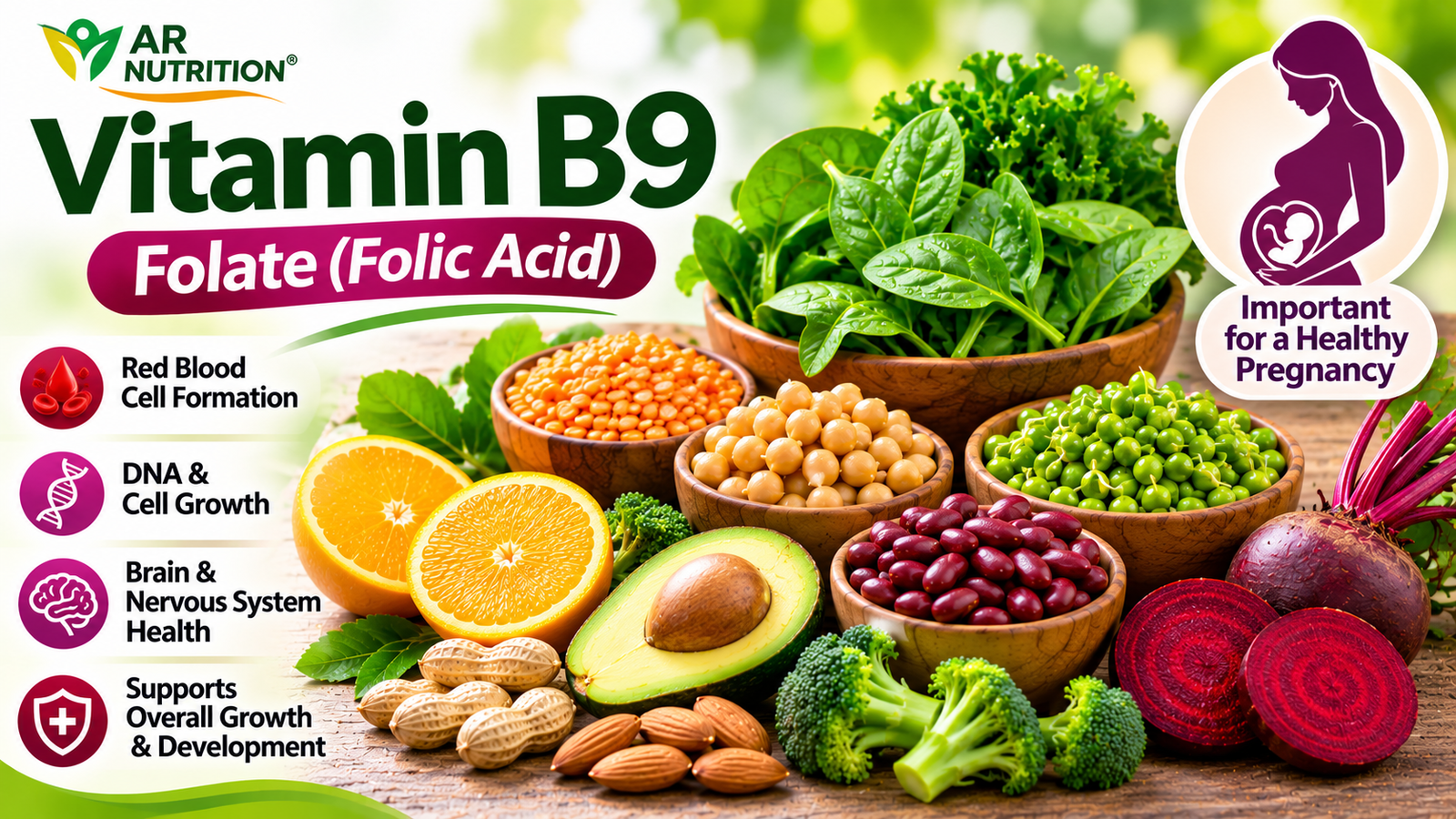
Vitamin B9, commonly known as folate, is an essential water-soluble vitamin that plays a major role in DNA synthesis, cell division, red blood cell formation and healthy growth. It is particularly important during pregnancy because it supports the early development of the baby's brain and spinal cord.
Vitamin B9 is naturally present in green leafy vegetables, lentils, chickpeas, beans, citrus fruits, nuts and several other foods. Its synthetic form, called folic acid, is commonly used in supplements and fortified foods.
Inadequate folate intake can cause megaloblastic anemia, fatigue, weakness and other health problems. During early pregnancy, insufficient folate can also increase the risk of neural tube defects in the developing baby.
In this article, we will explore vitamin B9 benefits, folate-rich Indian foods, daily requirements, deficiency symptoms, pregnancy needs and practical dietary tips.
What Is Vitamin B9?
Vitamin B9 is a water-soluble B-complex vitamin involved in several essential biological processes.
It is commonly discussed in two forms:
1. Folate
Folate refers to the naturally occurring forms of vitamin B9 found in foods such as spinach, lentils, chickpeas and other vegetables.
2. Folic Acid
Folic acid is the synthetic form of vitamin B9 used in supplements and many fortified foods. It is more stable than naturally occurring food folates.
The body converts folate into biologically active forms that participate in DNA production, amino acid metabolism and cell division.
Vitamin B9 is especially important for tissues where cells divide rapidly, such as bone marrow and developing embryonic tissues.
Health Benefits of Vitamin B9
1. Supports Red Blood Cell Formation
One of the most important functions of folate is its role in red blood cell production.
Folate helps the body produce DNA required for the development and division of red blood cell precursors in the bone marrow.
When folate levels are inadequate, red blood cells may become unusually large and immature. This condition is called megaloblastic anemia.
Common symptoms may include:
Tiredness.
Weakness.
Pale skin.
Dizziness.
Shortness of breath.
Reduced concentration.
Adequate folate intake supports normal blood cell production.
2. Supports Healthy Pregnancy
Vitamin B9 is particularly important before conception and during early pregnancy.
It supports the development of the neural tube, which later forms the baby's brain and spinal cord.
Insufficient folic acid intake around conception and during early pregnancy increases the risk of neural tube defects, including:
Spina bifida.
Anencephaly.
Because neural tube development occurs very early in pregnancy, women who may become pregnant are generally advised to obtain adequate folic acid before conception.
3. Helps in DNA and RNA Synthesis
Folate is required for the production of DNA and RNA, which carry genetic information and support normal cellular activities.
DNA synthesis is particularly important during periods of rapid growth and cell division.
Folate therefore plays an important role in:
Childhood growth.
Tissue repair.
Pregnancy.
Red blood cell formation.
Normal cell division.
4. Supports Brain and Nervous System Function
Vitamin B9 participates in the metabolism of amino acids and the production of compounds involved in normal nervous system function.
It also works alongside vitamin B12 in important metabolic pathways.
Inadequate folate levels may be associated with neurological and cognitive symptoms, although these symptoms can have many other causes.
Adequate intake is important, but taking extra folic acid has not been established as a general way to improve memory or prevent neurological diseases in people who are not deficient.
5. Helps Maintain Normal Homocysteine Levels
Homocysteine is an amino acid produced during normal protein metabolism.
Folate participates in converting homocysteine into methionine, with vitamin B12 also playing an important role in this process.
Inadequate folate, vitamin B12 or vitamin B6 status can contribute to elevated homocysteine levels.
However, lowering homocysteine through vitamin supplementation has not consistently been shown to prevent heart attacks or other cardiovascular events.
6. Supports Healthy Cell Growth
Folate is needed for normal cell division and tissue development.
It is particularly important during:
Pregnancy.
Childhood.
Adolescence.
Periods of tissue growth and repair.
A varied diet containing folate-rich foods supports normal cellular function.
7. Supports Normal Amino Acid Metabolism
Folate helps enzymes process certain amino acids and supports the conversion of homocysteine into methionine.
These reactions are important for normal metabolism and the production of compounds required by the body.
Vitamin B9-Rich Foods in India
Indian diets offer many affordable and accessible sources of natural folate.
1. Green Leafy Vegetables
Green leafy vegetables are among the most useful sources of folate.
Include:
Spinach (palak).
Amaranth leaves (chaulai).
Fenugreek leaves (methi).
Mustard greens (sarson).
Moringa leaves (drumstick leaves).
Bathua.
These vegetables can be used in dal, sabzi, paratha, soups and other preparations.
2. Pulses and Legumes
Legumes are valuable sources of folate and plant-based protein.
Include:
Chickpeas (chana).
Kidney beans (rajma).
Lentils (masoor dal).
Green gram (moong).
Black gram (urad dal).
Bengal gram.
Black-eyed peas (lobia).
Soybeans.
Regularly including different pulses can help improve folate intake.
3. Fruits
Some fruits that provide folate include:
Orange.
Papaya.
Avocado.
Banana.
Guava.
Other seasonal fruits.
Citrus fruits are particularly useful because they also provide vitamin C.
4. Nuts and Seeds
Include:
Peanuts.
Almonds.
Sunflower seeds.
Sesame seeds.
Walnuts.
They also provide healthy fats, fiber and other nutrients.
5. Vegetables
Other useful choices include:
Broccoli.
Beetroot.
Brussels sprouts.
Asparagus.
Green peas.
Cauliflower.
A variety of vegetables helps improve overall dietary quality.
6. Animal-Based Foods
For people who consume animal foods, some sources include:
Liver.
Eggs.
Fish.
Meat.
Liver can contain substantial folate, but it is also very high in preformed vitamin A. Pregnant women should avoid liver and liver products unless specifically advised by their healthcare professional.
Folate vs Folic Acid: What Is the Difference?
Although the terms are often used interchangeably, folate and folic acid are not exactly the same.
| Feature | Folate | Folic acid |
|---|---|---|
| Form | Naturally occurring vitamin B9 | Synthetic form of vitamin B9 |
| Sources | Green vegetables, legumes, fruits | Supplements and fortified foods |
| Stability | More sensitive to heat and storage | More stable |
| Absorption | Generally less bioavailable | Generally more bioavailable |
| Common use | Daily dietary intake | Supplements and food fortification |
Both forms contribute to the body's vitamin B9 requirements.
Daily Requirement of Vitamin B9
The daily requirement depends on age, sex and physiological condition.
The following adult values are from the ICMR-NIN 2020 Indian nutrient recommendations:
| Group | Recommended daily intake |
|---|---|
| Adult men | 300 mcg |
| Adult women | 220 mcg |
| Pregnant women | 570 mcg |
| Lactating women | 330 mcg |
These values refer to dietary folate intake. Requirements for children and adolescents differ according to age and sex.
Importance of Folic Acid Before and During Pregnancy
Folic acid is especially important for women who are planning pregnancy or may become pregnant.
The baby's neural tube develops during the early weeks of pregnancy, often before a woman knows she is pregnant.
Adequate folic acid intake before conception and during early pregnancy helps reduce the risk of neural tube defects.
Public health guidance commonly recommends 400 mcg of folic acid daily for women who may become pregnant, beginning before conception and continuing through early pregnancy. Individual recommendations may differ for women with certain medical histories or risk factors.
Pregnant women should follow the supplementation advice of their obstetrician or healthcare professional. Higher doses may be recommended in specific high-risk situations, but should not be self-prescribed.
Vitamin B9 Deficiency
Vitamin B9 deficiency occurs when the body does not receive or absorb enough folate to meet its needs.
It can affect red blood cell production, cell division and normal tissue growth.
Common Symptoms of Folate Deficiency
Possible symptoms include:
Persistent tiredness.
Weakness.
Pale skin.
Shortness of breath.
Headaches.
Irritability.
Sore or swollen tongue.
Mouth ulcers.
Reduced appetite.
Difficulty concentrating.
Folate deficiency may cause megaloblastic anemia, in which red blood cells become larger than normal.
Symptoms may develop gradually and can resemble those of vitamin B12 deficiency or other medical conditions.
Causes of Vitamin B9 Deficiency
1. Poor Dietary Intake
A diet that regularly lacks green leafy vegetables, legumes, fruits and other folate-rich foods may increase deficiency risk.
2. Increased Requirements During Pregnancy
Folate requirements increase during pregnancy because of rapid cell growth and development.
3. Alcohol Consumption
Excessive alcohol consumption can interfere with folate intake, absorption and metabolism.
4. Digestive Disorders
Conditions such as coeliac disease and inflammatory bowel disease may affect nutrient absorption.
5. Certain Medications
Some medications, including certain anti-seizure medicines and methotrexate, can interfere with folate metabolism.
Do not stop prescribed medication without medical advice.
6. Increased Cell Turnover
Some medical conditions that increase the production or breakdown of blood cells may increase folate requirements.
How Is Vitamin B9 Deficiency Diagnosed?
A healthcare professional may evaluate symptoms, medical history, dietary habits and laboratory results.
Common investigations include:
1. Complete Blood Count (CBC)
A CBC helps assess:
Hemoglobin.
Red blood cell count.
Mean corpuscular volume (MCV).
Other red blood cell indices.
Folate deficiency may cause macrocytic or megaloblastic anemia, where red blood cells are larger than normal.
2. Serum Folate
A blood test may be used to assess folate status.
3. Vitamin B12 Test
Vitamin B12 should also be assessed when folate deficiency is suspected because both deficiencies can cause megaloblastic anemia.
4. Additional Tests
Depending on the situation, a doctor may recommend other investigations to identify the underlying cause, including tests for malabsorption or other nutritional deficiencies.
Important: Folic acid supplementation can improve the anemia associated with vitamin B12 deficiency without treating its neurological effects. Therefore, vitamin B12 deficiency should be considered before treating suspected folate deficiency with high-dose folic acid alone.
Sample Indian Diet Plan for Vitamin B9
The following is an illustrative meal plan using commonly available Indian foods. It is not a prescribed diet or a guarantee of a particular folate intake.
| Meal | Food options |
|---|---|
| Early morning | Orange or seasonal fruit |
| Breakfast | Vegetable poha with peanuts |
| Mid-morning | Papaya or guava |
| Lunch | Roti, dal, palak sabzi and salad |
| Evening snack | Sprouts chaat with lemon |
| Dinner | Rice or roti, rajma or chana and mixed vegetables |
| Optional | Curd or milk according to individual needs |
Vegetarians can obtain folate from legumes, green leafy vegetables, fruits, nuts and seeds.
Vitamin B9 Supplements: Uses and Precautions
Folic acid supplements may be recommended for:
Pregnancy planning.
Pregnancy.
Confirmed folate deficiency.
Certain medical conditions.
People taking medicines that interfere with folate metabolism.
Folic acid is available as:
Folic acid tablets.
Prenatal multivitamins.
Vitamin B-complex supplements.
Multivitamin and mineral formulations.
The dose depends on the reason for supplementation and individual health requirements.
Can Too Much Folic Acid Be Harmful?
High intake of folic acid from supplements or fortified foods can create problems.
One important concern is that high-dose folic acid may correct the anemia caused by vitamin B12 deficiency while neurological damage continues.
This may delay recognition and treatment of vitamin B12 deficiency.
The US National Institutes of Health sets an adult upper limit of 1,000 mcg per day for folic acid from supplements and fortified foods, excluding medically supervised treatment. Indian recommendations may differ, so this should not be treated as a personal dosage target.
Do not take high-dose folic acid supplements without professional guidance.
Practical Tips to Maintain Healthy Folate Levels
Include green leafy vegetables regularly.
Eat pulses such as lentils, chickpeas and rajma.
Include citrus fruits and other seasonal fruits.
Add nuts and seeds to your meals.
Avoid excessive alcohol consumption.
Use a variety of vegetables in your daily diet.
Follow recommended folic acid supplementation before and during pregnancy.
Do not self-medicate with high-dose folic acid.
Consider vitamin B12 testing when folate deficiency or megaloblastic anemia is suspected.
Seek medical advice for persistent fatigue, weakness or other symptoms.
Frequently Asked Questions (FAQs)
1. What is another name for vitamin B9?
Vitamin B9 is commonly known as folate. Folic acid is its synthetic form used in supplements and fortified foods.
2. Which Indian foods are rich in vitamin B9?
Spinach, methi, amaranth leaves, lentils, chickpeas, rajma, green peas, peanuts and citrus fruits are useful sources of folate.
3. Is folic acid important during pregnancy?
Yes. Adequate folic acid intake before conception and during early pregnancy helps reduce the risk of neural tube defects in the developing baby.
4. Can vitamin B9 deficiency cause anemia?
Yes. Folate deficiency can cause megaloblastic anemia, in which red blood cells become larger than normal and may not develop properly.
5. What is the difference between folate and folic acid?
Folate is naturally found in foods, while folic acid is the synthetic form used in supplements and fortified foods.
6. Can vegetarians get enough folate?
Yes. Green leafy vegetables, lentils, chickpeas, beans, peanuts, fruits and other plant foods provide folate.
7. Does folate help in red blood cell production?
Yes. Folate is essential for DNA synthesis and normal red blood cell development.
8. Can folic acid improve hair growth?
Folate is important for normal cell growth, but there is insufficient evidence that extra folic acid improves hair growth in people who are not deficient.
9. Can I take folic acid tablets daily?
Folic acid may be recommended in certain situations, particularly before and during pregnancy. The appropriate dose depends on individual requirements and medical advice.
10. Can folic acid hide vitamin B12 deficiency?
High-dose folic acid can improve the anemia associated with vitamin B12 deficiency without correcting its neurological effects. Vitamin B12 status should be considered when treating suspected folate deficiency.
Conclusion
Vitamin B9 (folate) is an essential water-soluble vitamin that supports DNA synthesis, red blood cell production, cell division and healthy development. It is especially important before conception and during early pregnancy because adequate folic acid intake helps reduce the risk of neural tube defects.
Indian foods such as spinach, methi, lentils, chickpeas, rajma, green peas, peanuts and citrus fruits can help provide natural folate.
A balanced diet is important, but people with confirmed deficiencies, increased requirements or certain medical conditions may need supplements. Always seek professional advice before taking high-dose folic acid, and consider vitamin B12 status when evaluating megaloblastic anemia.
Medical Disclaimer: This article is for general educational purposes and is not a substitute for medical diagnosis or treatment. Pregnant women and people planning pregnancy should follow their healthcare professional's advice regarding folic acid supplementation.
References
ICMR- National Institute of Nutrition. Nutrient Requirements for Indians: Recommended Dietary Allowances and Estimated Average Requirements, 2020.
ICMR-National Institute of Nutrition. Dietary Guidelines for Indians, 2024.
National Institutes of Health, Office of Dietary Supplements. Folate: Fact Sheet for Health Professionals.
World Health Organization. Guideline: Daily iron and folic acid supplementation in pregnant women.






💬 Comments (0)
Be respectful. Website links and phone numbers are not allowed.